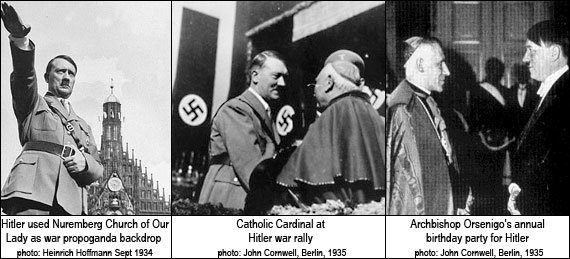
Cardinal Faulhaber, who helped negotiate the concordat with Hitler (and who ordained the present pope), assessed its international impact in a 1937 sermon:
“At a time when the heads of the major nations in the world faced the new Germany with cool reserve and considerable suspicion, the Catholic Church, the greatest moral power on earth, through the Concordat expressed its confidence in the new German government.“
- Guenter Lewy, The Catholic Church and Nazi Germany
concordatwatch.eu
 |
| Fritz Hirschberger, a Holocaust surivivor, painted a Nazi officer and a faceless Cardinal (Pacelli) standing on the body of a Jewish prisoner. He titled it "The Concordat". |
The following articles of the
Reichskonkordat are of special relevance:
Article 5
In the exercise of their clerical activities the clergy enjoy the protection of the state in the same way as state officials. The state will proceed, in accordance with the general provisions of civil law, against any insult to their person or to their clerical capacity, as well as against any interference with the duties of their office and, if necessary, will provide official protection.
concordatwatch.eu
Article 16
Before bishops take possession of their dioceses they are to take an oath of loyalty either to the Reich governor of the state (Land) concerned or to the President of the Reich respectively, according to the following formula:
“Before God and on the Holy Gospels I swear and promise, as becomes a bishop, loyalty to the German Reich and to the State (Land) of . . . I swear and promise to honour the legally constituted government and to cause the clergy of my diocese to honour it. With dutiful concern for the welfare and the interests of the German state, in the performance of the ecclesiastical office entrusted to me, I will endeavor to prevent everything injurious which might threaten it." concordatwatch.eu
In anticipation of a possible war Germany may become involved in:
Article 27
For the German army pastoral care outside the realm of ordinary jurisdiction is conceded for its Catholic officers, officials and men, as well as for their families.
The administration of such pastoral care for the army is the duty of thearmy bishop. His Church appointment is to be made by the Holy See after contact has been made with the Reich Government in order, with its agreement, to select a suitable person.
The Church appointment of military chaplains and other military clergy will be made by the army bishop after prior consultation with the appropriate authorities of the Reich. He may appoint only such chaplains as receive permission from their diocesan bishop to undertake military pastoral work, together with a certificate of suitability. Military chaplains have the rights of parish priests with regard to the troops and other army personnel assigned to them.
Detailed regulations for the organisation of pastoral work by chaplains will be supplied by an Apostolic Brief. Regulations for the legal aspects in terms of officials will be drawn up by the Reich Government.
concordatwatch.eu
And then we have the less known Secret Supplement belonging to the articles:
Secret Supplement
In case of a change in the present German armed forces in the sense of the introduction of universal conscription, the induction of priests and other members of the regular clergy and the orders into military service will, with the understanding of the Holy See, be arranged within the framework of approximately the following guiding ideas:
a) Students of philosophy and theology at Church institutions who are preparing themselves for the priesthood are to be freed from military service and the preparatory drills for it, except in the case of a general mobilisation.
b) In the case of a general mobilization clerics who are employed in the diocese administration or the military chaplaincy are freed from reporting for duty. This applies to ordinaries, members of the ordinariate, provosts of seminaries and Church residences for seminarians, professors at the seminaries, parish priests, curates, rectors, coadjucators and the clerics who provide a church with worship services on a continuing basis.
c) The remaining clerics, insofar as they are considered suitable, are to join the armed forces of the state in order to devote themselves to pastoral care for the troops under the Church jurisdiction of the military bishops, if they are not inducted into the medical unit.
d) The remaining clergy in sacris or members of orders, who are not yet priests are to be assigned to the medical unit. The same shall apply when possible to the candidates for the priesthood mentioned in a) who have not yet taken their final vows.
concordatwatch.eu
Note that this Secret Supplement together with Article 27, seems to be counter to the restrictions imposed by the
Versailles Treaty on Germany. It can be rightfully deduced that the people responsible for drafting up the
Reichkonkordat were anticipating Germany to become embroiled in a new future war.
 |
Fra. Bernhard Vaughan, S.J. |
“Exterminate the [German Lutheran] Hun rats!” {6}
Bernard Vaughan, 1915; English Jesuit; Advisor to King George V; Advisor to President Theodore Roosevelt; Advisor to President William H. Taft; Advisor to James Cardinal Gibbons; quoted in
Eric Jon Phelps’ – Vatican Assassins III (page 1015)
 |
| Hermann Rauschning |
" ‘I learnt most of all from the Jesuit Order‘, Hitler told me. ‘So far, there has been nothing more imposing on earth than the hierarchical organization of the Catholic Church. A good part of that organization I have transported direct to my own party...” Hermann Rauschning quoting Hitler,
Edmond Paris – The Vatican Against Europe (p 252-253)
 |
| Himmler, head of the occult SS elite troops |
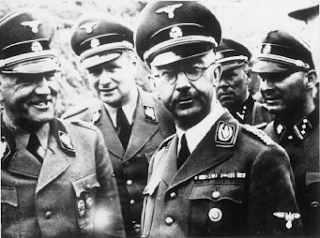 |
| Heinrich Himmler - Reichsführer-SS |
![]()